Keeping the Lone Star State Flowing: Industrial Water Heating Solutions for Texas Food & Beverage Giants
Category: Water heaters
Tags: Boiler, electric boiler, Electric water heaters, Gas boiler, heating system, industrial heater systems, industrial water heater, Sanitization, Texas, Texas food industry, water heater, water heater systems, water heaters, Water heaters in industrial environments
When it comes to heavy industry, commerce, and large-scale manufacturing, everything really is bigger in Texas. From bustling food processing plants along the I-35 corridor and massive distribution centers in Dallas-Fort Worth to petrochemical hubs near the Gulf Coast and bustling hospitality networks in San Antonio and Houston, the demand for reliable, high-volume hot water is completely non-negotiable.
Among all the heavy-hitting sectors operating across the Lone Star State, the Food & Beverage Processing Industry—alongside commercial hospitality, healthcare, and industrial laundries—stands out as the absolute heavyweight champion of hot water consumption.
Below is an in-depth look at why Texas food and beverage processors lead the state in thermal energy demand, the strict operational requirements they face, and how advanced commercial heating technologies (such as high-efficiency Raypak and industrial heating solutions) keep these massive operations running smoothly.
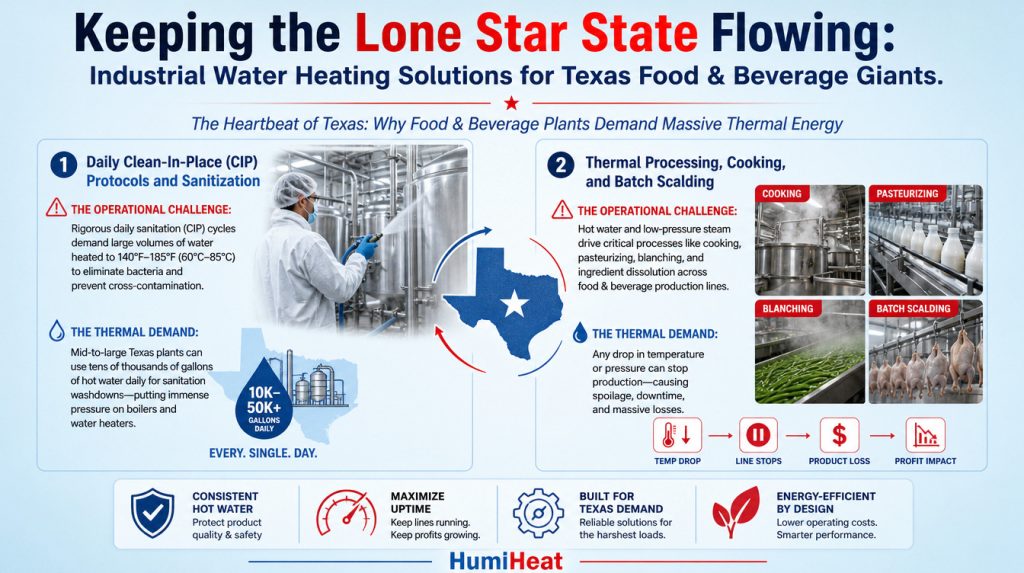
The Heartbeat of Texas: Why Food & Beverage Plants Demand Massive Thermal Energy
Texas ranks among the largest agricultural and food-manufacturing states in the United States. Processing beef, poultry, dairy, beverages, and packaged goods requires rigorous adherence to safety standards set by the USDA and the FDA. In this high-stakes environment, hot water is not just a utility; it is a critical sanitization and production tool.
1. Daily Clean-In-Place (CIP) Protocols and Sanitization
- The Operational Challenge: Food processing facilities must undergo rigorous daily sanitation cycles to eliminate bacteria, organic residues, and cross-contamination risks. This process—known as Clean-In-Place (CIP)—requires massive, continuous volumes of water heated to high temperatures (typically between 140°F and 185°F / 60°C to 85°C).
- The Thermal Demand: A single mid-to-large-scale meat processing plant or dairy facility in Texas can consume tens of thousands of gallons of hot water daily just for sanitation washdowns, putting immense pressure on plant boilers and water heaters.
2. Thermal Processing, Cooking, and Batch Scalding
- The Operational Challenge: Beyond cleanup, hot water and low-pressure steam serve as the primary thermal transfer mediums for cooking, pasteurizing, blanching, and dissolving ingredients in commercial beverage and food production lines.
- The Thermal Demand: Any unexpected drop in water temperature or pressure halts the entire production line, resulting in massive batch spoilage, costly downtime, and severe profit losses.
Other Texas Industries Driving Heavy Hot Water Demand
While food processing leads the pack, several other key Texas sectors share an insatiable appetite for industrial hot water:
- Petrochemical and Refining (Houston & Gulf Coast): Refineries utilize heavy-duty industrial water heaters and boilers for boiler feed water preheating, tank viscosity maintenance, and complex chemical processes.
- Healthcare and Hospitality (Texas Medical Center, Austin, & DFW): Massive hospital networks and high-end hotel chains require uninterrupted, code-compliant domestic hot water (DHQ) for patient care, sterilization, commercial kitchens, and massive industrial laundries.
- Commercial Industrial Laundries: Large-scale laundry plants servicing Texas hospitals and hotels operate washing tunnels and extractors that run continuously on high-temperature water, making thermal efficiency a direct driver of their profit margins.
Engineering for Texas: Choosing the Right Heating Technology
To survive the punishing duty cycles required by Texas industries, plant managers and project engineers cannot rely on residential-grade equipment. They require robust commercial systems designed for high flow rates, energy efficiency, and low operational expenditure (OPEX).
1. High-Efficiency Modulating Boilers (e.g., Raypak HiDelta & MVB Series)
Commercial facilities with fluctuating demand benefit heavily from modulating gas boilers. Instead of operating on a wasteful “all-or-nothing” cycle, these units adjust their burner output in real time to match exact facility demand, drastically cutting natural gas or propane waste.
2. Condensing Technology (e.g., Raypak XTherm)
For massive food plants and hospitals looking to slash their carbon footprint and utility bills, condensing boilers extract latent heat from flue gases, achieving thermal efficiencies exceeding 95% to 97%. This is a game-changer for facilities running 24/7 operations in Texas.
3. Corrosion-Resistant Heat Exchangers
Texas water supplies can vary greatly in hardness and mineral content. Utilizing commercial heaters built with cupronickel or stainless steel heat exchangers prevents premature scaling and failure caused by hard water or aggressive daily chemical washdowns.
Operational Value Breakdown for Texas Facility Managers
| Industry Sector in Texas | Primary Hot Water Challenge | Recommended Heating Technology Solution |
| Food & Beverage Processing | Massive continuous flow for CIP washdowns | High-capacity modulating gas boilers & storage tanks |
| Petrochemical & Refining | High pressure and harsh chemical environments | Heavy-duty industrial process water heaters |
| Hospitals & Hotels | Peak demand spikes and zero downtime tolerance | Cascading multi-unit commercial boiler systems |
| Industrial Laundries | High-volume continuous hot water supply | Ultra-efficient condensing water heaters |
Conclusion: Powering Texas Industry Forward
In the fast-paced, high-volume industrial landscape of Texas, reliable hot water is the silent engine of productivity. Whether it’s a food processing plant sanitizing lines in Fort Worth, a refinery operating on the Gulf Coast, or a hospital complex in Houston, specifying the right industrial water heating equipment—such as advanced modulating boilers and high-efficiency systems—ensures regulatory compliance, protects against costly downtime, and keeps Texas businesses running at peak performance.