Industrial Humidity Control: Why Texas’s Booming Food and Beverage Sector Requires Advanced Humidification Systems
Category: Humidifiers
Texas has emerged as one of the nation’s premier economic powerhouses, experiencing an unprecedented industrial expansion driven by business-friendly policies, strategic logistics corridors, and a massive population influx. Among the fastest-growing sectors in the Lone Star State is the food and beverage manufacturing industry. From commercial bakeries and artisan tortilla plants to large-scale meat processing facilities, beverage bottling plants, and food packaging hubs, industrial hubs across Houston, Dallas-Fort Worth, San Antonio, and Austin are scaling up rapidly.
However, operating a modern food production facility in the Texas climate introduces a complex set of environmental challenges. While facility managers routinely invest heavily in heavy-duty HVAC systems, refrigeration, and washing protocols, one critical operational factor is frequently overlooked until it causes costly production failures: indoor relative humidity (RH).
To maintain strict food safety standards, prevent raw material waste, protect sensitive packaging lines, and ensure worker health, Texas food and beverage processors are increasingly integrating advanced commercial and industrial humidification technologies—such as those engineered by industry leaders featured at Humiheat.
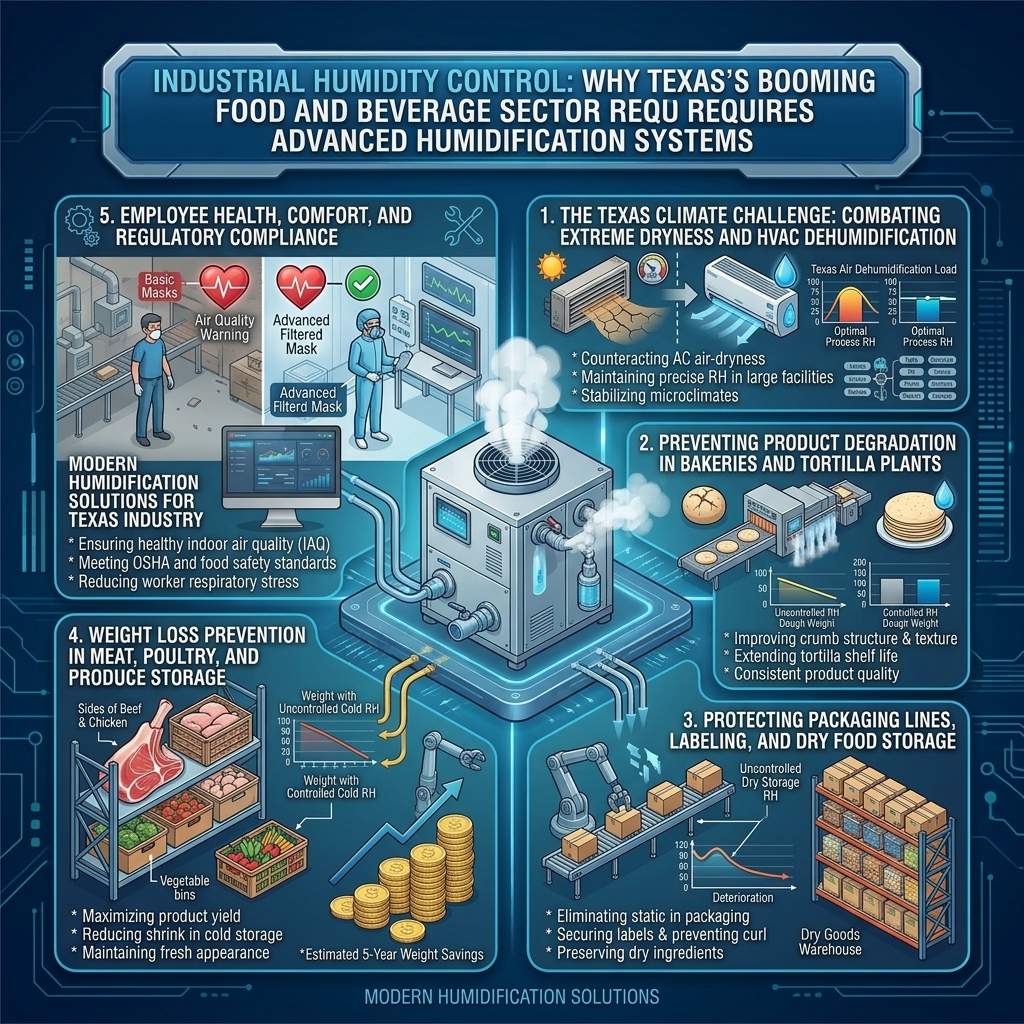
1. The Texas Climate Challenge: Combating Extreme Dryness and HVAC Dehumidification
A common misconception among facility managers is that Texas humidity naturally solves indoor moisture needs. While outdoor coastal regions experience high humidity, the vast majority of industrial processing plants rely on massive commercial air conditioning and ventilation (HVAC) systems to cool massive workspaces against intense regional heat.
- The Drying Effect of Industrial Cooling: When high-capacity cooling systems strip moisture from incoming air to combat the Texas heat, the resulting indoor relative humidity can plummet to dangerously low levels (often below 30% RH).
- The Operational Hazard: Excessively dry air inside a food processing plant creates an unstable microclimate. It accelerates the evaporation of moisture from unpackaged food products, generates static electricity that disrupts automated packaging lines, and compromises the structural integrity of porous organic materials. Industrial humidifiers are essential to counteract this mechanical dryness, restoring precise moisture balance without introducing condensation risks.
2. Preventing Product Degradation in Bakeries and Tortilla Plants
The bakery and snack food sectors represent a massive component of the Texas food manufacturing landscape. Whether producing mass quantities of bread, pastries, or traditional flour and corn tortillas, managing dough hydration is the absolute core of product quality.
- Dough Fermentation and Proofing: Yeast activity and flour hydration depend entirely on ambient environmental conditions. In an unhumidified, dry Texas plant, dough surfaces dry out rapidly, forming a premature skin (crusting) that prevents proper expansion during proofing and baking.
- The Humidification Solution: Advanced industrial humidification systems maintain an optimal relative humidity range (typically between 70% and 80% RH) in proofing rooms and mixing areas. This prevents moisture loss, ensures uniform texture, eliminates cracking, and guarantees that baked goods meet strict commercial consistency standards before packaging.
3. Protecting Packaging Lines, Labeling, and Dry Food Storage
For food processing plants specializing in dry goods, cereals, spices, powdered mixes, and snack packaging, low humidity causes severe mechanical disruptions and material degradation.
- Static Electricity and Packaging Jams: Dry air creates severe static electricity (Electrostatic Discharge). In high-speed packaging and labeling lines, static causes lightweight plastic films, cardboard boxes, and paper labels to cling incorrectly, leading to frequent line jams, misaligned seals, and massive packaging waste.
- Cardboard and Paper Integrity: Corrugated boxes stored in dry industrial warehouses lose their structural rigidity. Low humidity strips moisture from paper fibers, decreasing the box’s stacking strength (Edge Crush Test ratings) and resulting in collapsed pallets during transit across Texas’s extensive distribution networks. Precise plant-wide humidification preserves packaging material integrity.
4. Weight Loss Prevention in Meat, Poultry, and Produce Storage
In the protein and fresh produce processing sectors—vital pillars of the Texas agricultural economy—water weight is literally profit.
- Shrinkage (Product Shrinkage): Unpackaged or unpackaged-in-breathable-films meat, poultry, and fresh vegetables stored in refrigerated coolers with dry air will steadily lose moisture through evaporation. This phenomenon, known as product shrinkage, directly reduces the saleable weight of perishable inventory.
- Maintaining Yield: Deploying commercial humidification or misting systems in cold storage areas maintains a saturated or high-humidity microclimate that suppresses moisture migration out of the food tissue. This protects profit margins by ensuring that every pound of meat or produce processed is a pound sold.
5. Employee Health, Comfort, and Regulatory Compliance
Food manufacturing facilities in Texas operate under rigorous local and federal regulations, including OSHA guidelines and FDA sanitation mandates. Indoor air quality plays a direct role in workforce safety and compliance.
- Respiratory Health: Extremely dry indoor air irritates mucous membranes, increases susceptibility to airborne pathogens, and elevates employee absenteeism due to respiratory discomfort, especially during seasonal temperature shifts.
- Dust Control: In facilities handling dry powders, flour, or starches, dry air allows particulate matter to remain suspended in the atmosphere indefinitely. Proper humidification weighs down airborne dust particles, improving indoor air quality and maintaining a safer, cleaner working environment for plant personnel.
Modern Humidification Solutions for Texas Industry
To address these diverse challenges, facility directors across Texas are turning to robust, automated solutions. Modern commercial humidifiers—ranging from electrode steam units and gas-fired systems to high-pressure atomization arrays—offer precise digital control, seamless integration with building management systems (BMS), and low maintenance overhead.
For Texas food and beverage manufacturers looking to upgrade their environmental control infrastructure, exploring engineered solutions via specialized platforms like Humiheat provides access to professional-grade equipment designed to withstand rigorous industrial demands.
Conclusion
As the food and beverage processing industry in Texas continues its rapid growth, maintaining strict environmental control inside manufacturing plants is no longer optional. Investing in industrial humidification protects baking yields, eliminates packaging line downtime, prevents product shrinkage in cold storage, and ensures compliance with health standards. By integrating advanced humidification technology, Texas industrial operators safeguard their product quality, protect their capital investments, and secure long-term operational profitability.