Combating Texas Summer Humidity: Industrial Dehumidification Strategies to Protect Infrastructure and Product Quality
Category: Dehumidifiers
Tags: Climatization, Control of humidity and temperature, Dehumidifier, Dehumidifiers, Desiccant, Desiccant Dehumidifiers, desiccant systems, desiccants, HumiHeat, Refrigerant Dehumidifiers, Texas
Learn how Humiheat’s industrial dehumidifiers protect Texas facilities, warehouses, and products from summer humidity, corrosion, and inventory loss.
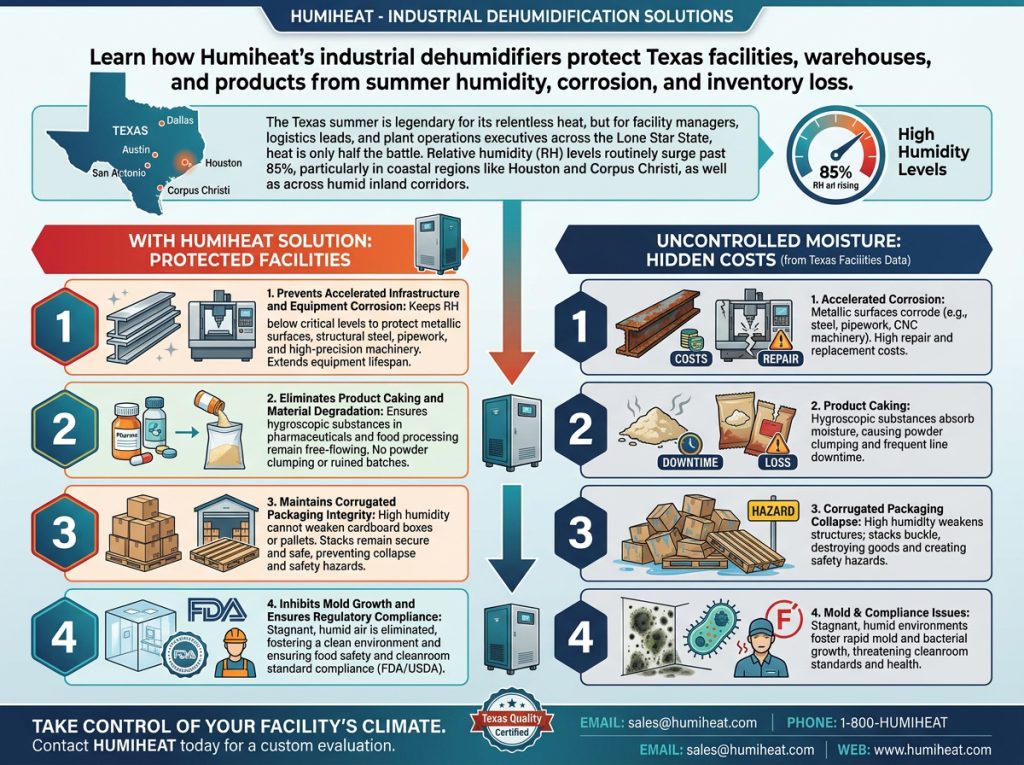
The Texas summer is legendary for its relentless heat, but for facility managers, logistics leads, and plant operations executives across the Lone Star State, heat is only half the battle. Relative humidity (RH) levels routinely surge past 85%, particularly in coastal regions like Houston and Corpus Christi, as well as across the humid inland corridors of Dallas, Austin, and San Antonio.
When high ambient temperatures pair with extreme moisture, industrial facilities turn into massive heat traps. Uncontrolled indoor humidity creates a destructive cascade: metal corrosion on heavy machinery, structural deterioration, mold outbreaks, caking of dry powders, and compromised packaging integrity.
To safeguard raw materials, equipment, and finished inventory, implementing targeted industrial dehumidification strategies with Humiheat systems is an operational essential for Texas businesses.
The Hidden Costs of Uncontrolled Moisture in Texas Facilities
High indoor humidity operates silently, gradually eroding product quality and driving up facility overhead. Operating an industrial building in Texas without specialized moisture management leads to severe operational risks:
- Accelerated Infrastructure and Equipment Corrosion: Metallic surfaces—including structural steel, pipework, electrical enclosures, and high-precision CNC machinery—corrode at an accelerated rate when relative humidity exceeds 60%. Replacing or repairing damaged capital equipment erodes profit margins.
- Product Caking and Material Degradation: Hygroscopic substances used in pharmaceuticals, food processing, plastics, and chemical manufacturing absorb airborne moisture quickly. This leads to powder clumping, ruined batch formulations, and frequent downtime on filling and packaging lines.
- Corrugated Packaging Collapse: High humidity weakens the structural integrity of cardboard boxes and wooden pallets. In high-density distribution centers, moisture-soaked packaging causes stacks to buckle, destroying stored goods and creating workplace safety hazards.
- Mold Growth and Regulatory Non-Compliance: Stagnant, humid indoor environments foster rapid mold and bacterial growth, threatening cleanroom standards, food safety compliance (FDA/USDA), and employee health.
How Industrial Dehumidification Restores Environmental Control
Relying solely on standard HVAC cooling units to handle heavy humidity loads in Texas is a costly mistake. Traditional air conditioners cool the air to manage temperature, but they lack the dedicated extraction capacity required to pull hundreds of pints of moisture from massive industrial spaces every day.
Dedicated Humiheat industrial dehumidification systems actively strip moisture from the air, maintaining relative humidity within a precise 35%–50% target range regardless of outdoor weather spikes.
Depending on your facility’s operational demands, two primary technology approaches are deployed:
- Refrigerant (Mechanical) Dehumidifiers: Ideal for warm, high-humidity environments like warehouses, assembly plants, and commercial buildings. They draw in humid air, cool it below its dew point to condense and drain the water, and recirculate dry, re-tempered air.
- Desiccant Dehumidifiers: Engine-built for cold-storage facilities, cleanrooms, and low-humidity manufacturing process areas. They use a silica-gel rotor to absorb moisture directly at the molecular level, capable of achieving ultra-low relative humidity levels even below freezing temperatures.
Strategic Advantages for Texas Operations
| Operational Area | Impact of Humiheat Moisture Control |
| Warehousing & Distribution | Preserves packaging rigidity, prevents rust on stored inventory, and protects electronic components. |
| Food & Beverage Processing | Prevents condensation on cold piping and ceilings, eliminating drip contamination risks. |
| Manufacturing & Assembly | Keeps metal parts free from flash rusting during production and extends machine lifespan. |
| Energy Efficiency | Reduces the latent load on central HVAC systems, lowering overall monthly energy expenditures. |
Protect Your Texas Business with Humiheat
Don’t let the oppressive Texas summer compromise your product quality, ruin your inventory, or accelerate equipment wear. Taking control of your indoor atmospheric conditions is a high-return investment that guarantees operational consistency year-round.
Humiheat provides a comprehensive lineup of heavy-duty industrial dehumidifiers, commercial moisture control systems, and tailored engineering solutions designed specifically to handle the extreme climate challenges of the Texas market.
Explore our full range of industrial moisture control technology at Humiheat and speak with an environmental control specialist today to custom-engineer the ideal dehumidification strategy for your facility.