Beef Belt Texan industry, main applications for dehumifider 158 liters
Category: Dehumidifiers
Tags: Dehumidifier, dehumidifier applications, Dehumidifiers, H2OTEK, industrial dehumidifiers, Industrial Refrigeration Dehumidifiers, Refrigeration Dehumidifiers, Texas
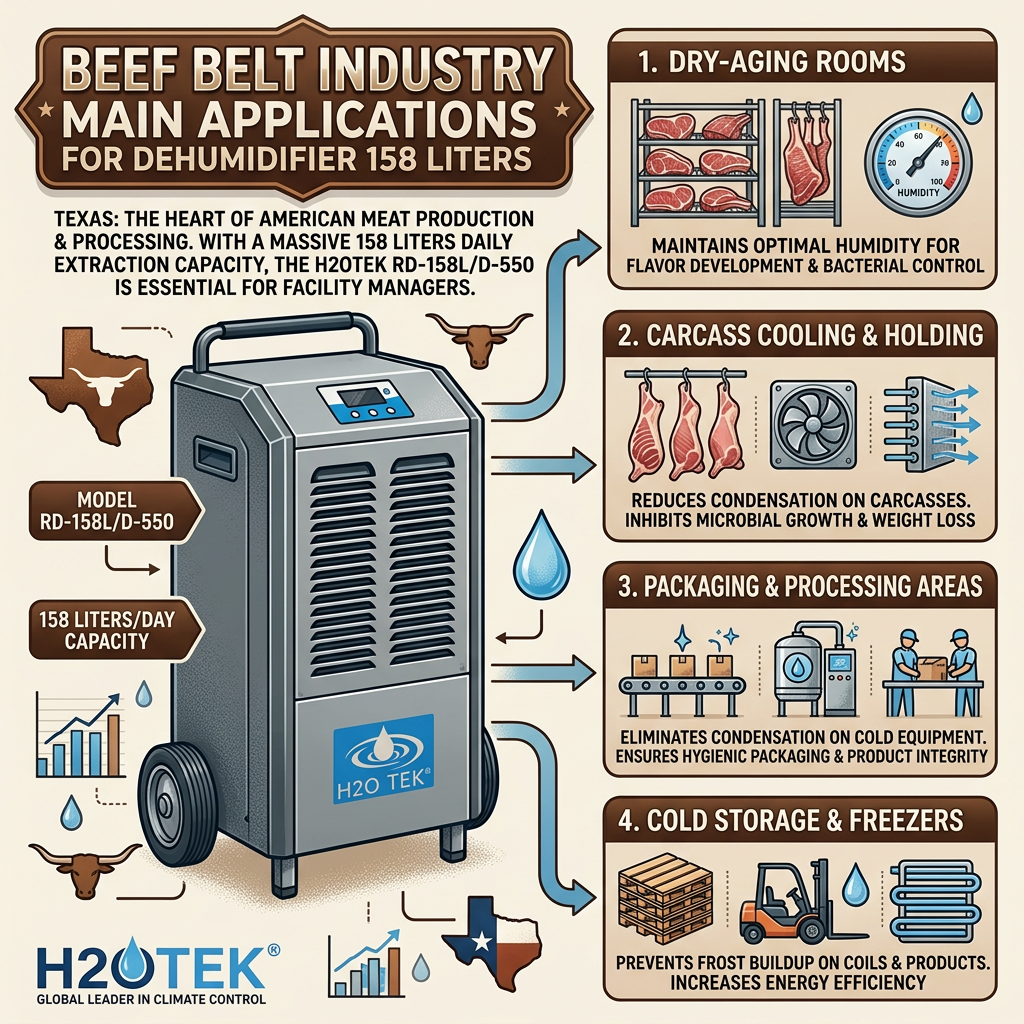
In the heart of the American “Beef Belt,” Texas remains the undisputed leader in meat production and processing. From the sprawling feedlots of the Panhandle to the high-tech distribution centers in DFW and Houston, the state’s multi-billion-dollar meat industry relies on a razor-thin margin of environmental control.
In this context, the H2OTEK Refrigeration Dehumidifier Model RD-158L/D-550, with its massive 158-liter daily extraction capacity, has become an essential asset for facility managers.
While it might seem counterintuitive to remove moisture from a product sold by weight, the reality is that uncontrolled humidity is the primary enemy of food safety, structural integrity, and shelf-life in the Texas meat storage industry.
1. Preventing “Surface Slime” and Microbial Growth
The most critical application of the RD-158L/D-550 in Texas meat lockers is the prevention of condensation on the product’s surface. Texas is known for its “humidity spikes,” where warm, moist air infiltrates cold storage bays during loading and unloading.
- The Science: When warm Texas air meets the cold surface of a beef carcass or a pallet of primal cuts, it reaches its dew point instantly, forming a thin film of water. This moisture is the perfect breeding ground for Pseudomonas and other spoilage bacteria that cause “surface slime.”
- The Application: By deploying the RD-158L/D-550, facilities can scrub the air of excess moisture faster than the refrigeration coils alone. This ensures the “pellicle” (the dry outer layer of the meat) remains intact, significantly extending the shelf-life of the beef before it reaches the consumer.
2. Eliminating “Ice Fog” and Fogging in Loading Docks
Texas meat distribution centers operate 24/7. When a refrigerated trailer opens its doors to a humid Houston or San Antonio afternoon, the result is often “Ice Fog”—a thick, blinding mist created by the massive temperature differential.
- The Hazard: Fog obscures the vision of forklift operators, leading to accidents. Furthermore, this moisture eventually settles on the floors, creating lethal slip-and-fall hazards in high-traffic zones.
- The Application: The RD-158L/D-550 is strategically placed in “staging areas” and loading docks. Its high-volume airflow (measured in CFM) acts as a dehumidification curtain, stripping the moisture from the incoming air before it can turn into fog. This keeps the floors dry and the visibility clear, directly impacting the facility’s safety rating.
3. Structural Integrity: Preventing “Ceiling Rain” and Mold
In large-scale Texas cold storage, a common nightmare is “Ceiling Rain.” This occurs when moisture condenses on the underside of the roof or on overhead cooling pipes and drips onto the exposed meat below.
- Regulatory Risk: Under USDA and FSIS (Food Safety and Inspection Service) guidelines, condensation dripping onto food products is a major non-compliance event that can lead to immediate facility shutdown.
- The Application: The H2OTEK RD-158L/D-550 provides the “brute force” necessary to keep the relative humidity (RH) low enough that the dew point is never reached on ceiling surfaces. Its industrial-grade refrigeration system is designed to operate in the cool temperatures of a meat-cutting room (typically 10 °C a 12 °C) without freezing up, thanks to its advanced defrost logic.
4. Optimization of Dry-Aging Rooms
Texas is famous for its premium, dry-aged steaks. Dry-aging is a delicate balance of temperature, airflow, and—most importantly—humidity.
- The Precision Requirement: If the humidity is too high, the meat will rot instead of age. If it is too low, the meat dries too quickly, leading to excessive “trim loss” (wasted meat).
- The Application: The RD-158L/D-550 allows pitmasters and butchers to dial in a specific RH (usually between 80% and 85%) with industrial consistency. While 85% sounds high, the massive amount of moisture released by the aging beef requires a unit with the 158-liter capacity of the H2OTEK to stay ahead of the evaporation curve.
Technical Edge: Why the RD-158L/D-550 for Texas Meat?
The Texas meat industry demands equipment that can survive “The Big Heat.” The H2OTEK Model RD-158L/D-550 stands out due to several industrial features:
- High Extraction Volume: 158 Liters/Day is equivalent to removing over 41 gallons of water. In a facility processing thousands of head of cattle per week, this capacity is the bare minimum required to maintain a safe environment.
- Washable Industrial Filters: Meat processing is an organic environment. The RD-158L/D-550 features heavy-duty filters that protect the internal coils from dust and organic particles, ensuring the unit doesn’t become a source of contamination itself.
- Continuous Drainage: In 24/7 meat plants, manual tank emptying is impossible. The unit’s direct-drain capability ensures it runs autonomously, piped directly into the floor drains.
5. Protecting Packaging and Labeling Integrity
Finally, the meat industry is about presentation. High humidity causes cardboard boxes (corrugated fiberboard) to lose their structural strength, often referred to as “box crush.” It also causes labels to peel off or become unreadable.
- The Application: In the final packaging and palletizing area, the RD-158L/D-550 ensures the air is dry enough that boxes remain rigid and barcodes remain scannable. This prevents logistical nightmares at the retail level, where unreadable labels can result in rejected shipments.
The Backbone of Texas Food Safety
The Texas meat industry is a testament to the power of industrial engineering. As the state continues to feed the world, the reliance on high-capacity environmental controls like the H2OTEK RD-158L/D-550 will only grow.
By managing the invisible threat of water vapor, this dehumidifier protects the quality of Texas beef, ensures the safety of workers, and maintains the strict hygiene standards required by law. For a Texas meat storage facility, the RD-158L/D-550 is not an option—it is a critical safeguard for the bottom line.