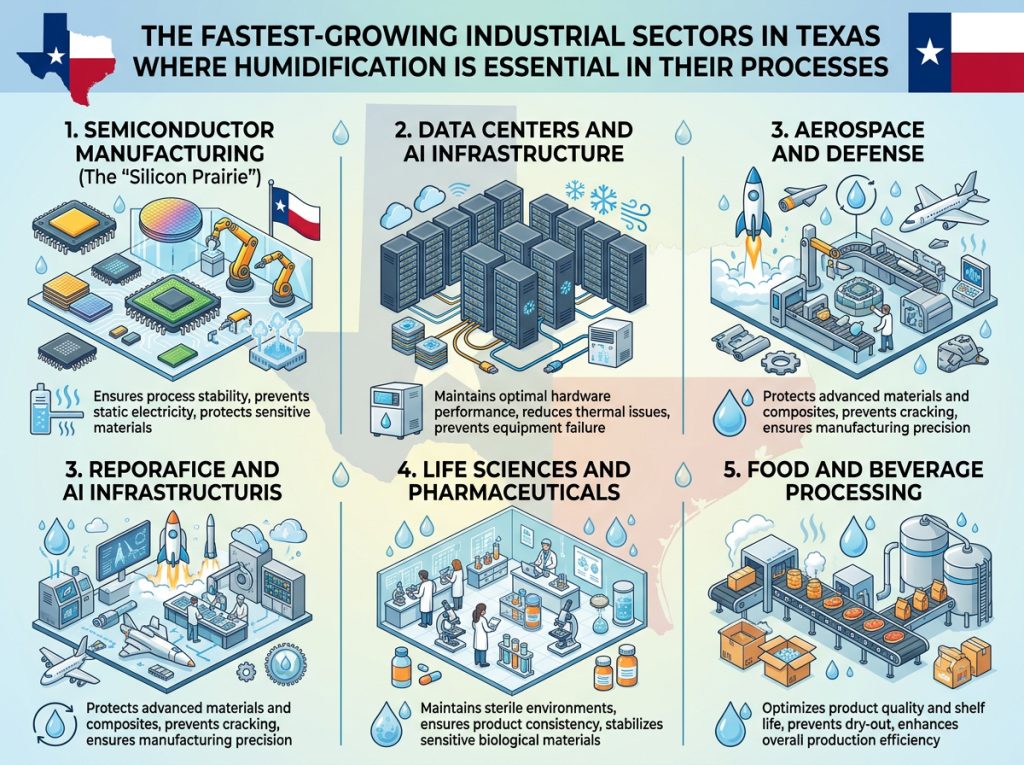
The fastest-growing industrial sectors in Texas where humidification is essential in their processes.
Category: Uncategorized
Tags: Control of humidity and temperature, food manufacturing, humidification, humidification system, humidifier, humidifier system, Humidifiers, humidity, humidity control, Industrial humidifiers, Temperature control
Texas has long been an economic titan, but as we move through 2026, its industrial landscape is shifting from traditional oil and gas toward high-tech manufacturing and digital infrastructure. While Texas is famous for its heat, many of these “new-age” industries face a silent enemy: dry air.
In industrial environments, maintaining specific Relative Humidity (RH) levels is not just about comfort—it is a critical requirement for production quality, safety, and equipment longevity. Here are the fastest-growing sectors in the Lone Star State where humidification is essential.
-
Semiconductor Manufacturing (The “Silicon Prairie”)
With massive investments from companies like Samsung in Taylor and Texas Instruments in Sherman, Texas has solidified its status as a global chip-making hub.
- Why Humidification Matters: Semiconductor “cleanrooms” are incredibly sensitive. If the air is too dry (typically below 30% RH), Electrostatic Discharge (ESD) becomes a massive threat. A single static spark, invisible to the human eye, can fry a microscopic circuit, ruining an entire batch of wafers.
- The Goal: Industrial humidifiers keep these environments at a steady 40–50% RH to suppress static and ensure that photoresist chemicals don’t evaporate too quickly.
-
Data Centers and AI Infrastructure
The explosion of Artificial Intelligence has led to a data center construction boom in North Texas and the San Antonio corridor. These facilities house thousands of servers that generate immense heat.
- Why Humidification Matters: To save on electricity, many Texas data centers use evaporative cooling. This process adds moisture to the air to lower temperatures. Furthermore, if the air becomes too dry, the risk of static discharge increases, which can cause server downtime or data corruption.
- The Impact: Proper humidification allows these “data farms” to run more efficiently, reducing their “Power Usage Effectiveness” (PUE) and protecting the hardware that powers our digital lives.
-
Aerospace and Defense
From SpaceX in South Texas to Lockheed Martin in Fort Worth, the aerospace sector is booming. This industry relies heavily on advanced composite materials (like carbon fiber) and precision painting.
- Why Humidification Matters: When layering composite materials, the resin requires specific humidity levels to bond correctly. Additionally, in paint booths, if the air is too dry, the paint can dry before it hits the surface (causing a “dusty” finish) or develop an “orange peel” texture.
- The Result: Consistent humidity ensures the structural integrity of aircraft parts and the aerodynamic perfection of their finishes.
-
Life Sciences and Pharmaceuticals
The Texas Medical Center in Houston and the growing biotech scene in Austin require ultra-controlled environments for drug manufacturing and laboratory research.
- Why Humidification Matters: Many pharmaceuticals are produced in powder form. If the humidity is too low, powders can become statically charged and “fly” away or stick to machinery, causing dosage inaccuracies. Conversely, if it’s too high, the powder clumps.
- The Standard: Maintaining a precise “sweet spot” in humidity is a regulatory requirement for many FDA-approved processes to ensure chemical stability.
-
Food and Beverage Processing
Texas is a leader in food manufacturing, from meat packing to large-scale bakeries.
- Why Humidification Matters: In industrial bakeries, humidity controls the “proof” of the dough and prevents the crust from cracking prematurely in the oven. In cold storage, humidification prevents evaporative weight loss in produce and meats. If a warehouse is too dry, the product literally loses weight (and value) to the air.
As Texas continues to lead the nation in industrial growth, the demand for precision climate control has never been higher. For these sectors, industrial humidification is not a luxury—it is a vital tool for preventing waste, ensuring safety, and maintaining the high-quality standards that the modern global market demands. Whether it’s protecting a $50,000 silicon wafer or ensuring a server farm stays online, moisture is the invisible guardian of Texas industry.