Choosing between isothermal and adiabatic humidification is more than a technical preference
Category: Humidifiers
Tags: Adiabatic Humidification, Control of humidity and temperature, humidification, humidification system, Humidifiers, humidity, Industrial humidifiers, Isothermal Humidification, ultrasonic humidifiers
It is a fundamental decision based on the laws of thermodynamics. In the industrial heart of Texas, where energy costs and precision are at the forefront of every ROI calculation, understanding the “how” and “why” of these systems is vital.
Here is a breakdown of how these two technologies stack up across the state’s fastest-growing sectors.
-
Isothermal Humidification (The “Steam” Standard)
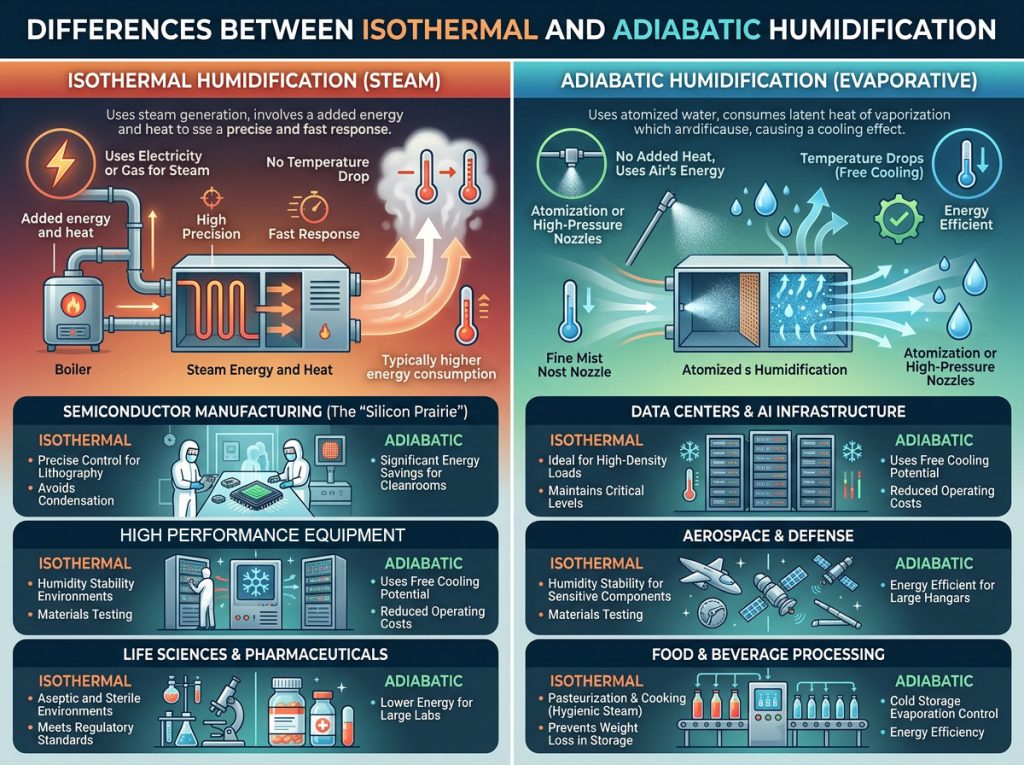
Isothermal systems use an external energy source—usually electricity, gas, or heat exchangers—to boil water and turn it into steam. This steam is then dispersed into the airflow.
- How it Works: Since the water is already at boiling point when it becomes a gas, it doesn’t “steal” heat from the surrounding air. The room temperature remains stable ($isothermal$ means “constant temperature”).
- Best For: Semiconductors and Pharmaceuticals.
- Why: Steam is inherently sterile. The boiling process kills most pathogens, and the high level of control allows for precision within $\pm 1\%$ RH. In a cleanroom where a single stray microbe or a 2% humidity swing can ruin a multimillion-dollar batch of microchips, the reliability of steam is the gold standard.
-
Adiabatic Humidification (The “Cool Mist” Alternative)
Adiabatic systems do not boil water. Instead, they use high-pressure nozzles, ultrasonic vibrations, or evaporative media to create a fine mist or film of water that evaporates into the air.
- How it Works: Physics dictates that evaporation requires energy (the latent heat of vaporization). Since the system doesn’t provide this energy via heat, the water “borrows” it from the surrounding air.
- The Result: The air temperature drops significantly as the humidity rises. This is known as the “evaporative cooling effect.”
- Best For: Data Centers and Food Processing/Storage.
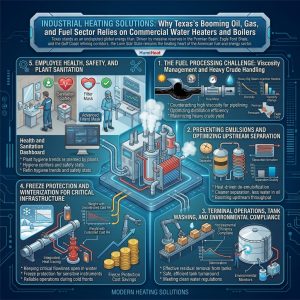
- Why: Data centers are massive heat engines. By using adiabatic systems, facilities get “free” cooling as a byproduct of humidification. This drastically lowers the load on the HVAC chillers, slashing energy bills.
-
Industrial Fit: The Comparison Matrix
| Feature | Isothermal (Steam) | Adiabatic (Evaporative/Mist) |
| Energy Consumption | High (Energy used to boil water) | Very Low (Energy used for a small pump) |
| Precision | Extremely High ($\pm 1-2\%$) | Moderate ($\pm 3-5\%$) |
| Cooling Effect | None (Neutral) | Significant (Cooling byproduct) |
| Maintenance | High (Scale/Mineral buildup) | Moderate (Water filtration required) |
| Sterility | Naturally sterile | Requires UV/RO water treatment |
-
Sector-Specific Applications
Aerospace and Defense: The Hybrid Need
Aerospace facilities often utilize a mix. In high-volume hangars where comfort and static control are the priority, adiabatic systems are preferred for their low operating costs. However, in the high-precision paint booths where chemical bonding is sensitive to temperature fluctuations, isothermal steam ensures the environment remains perfectly stable.
Food and Beverage: Protecting the Weight
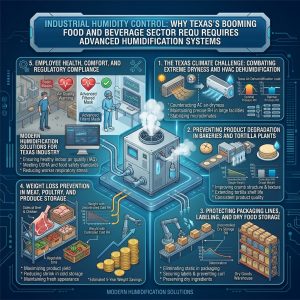
In cold storage and meat packing, adiabatic systems are the champions. Because these environments already need to be cold, the cooling effect of the misting system assists the refrigeration units. Furthermore, it prevents “evaporative weight loss” in products without adding the heat load that a steam system would introduce.
-
The Verdict for the Texas Market
In the current economic climate, the trend in Texas is leaning heavily toward adiabatic technology wherever possible due to the massive energy savings and the cooling benefits during the long summer months. However, for the high-purity demands of the “Silicon Prairie,” isothermal remains irreplaceable.
Pro Tip: When choosing an adiabatic system, the water quality is non-negotiable. Without a Reverse Osmosis (RO) system, you aren’t just spraying water; you are spraying “dust” (minerals) that will eventually coat your sensitive electronics.