The Texas Industrial Boom: Why Climate Change is Driving the Need for Industrial Humidifiers
Category: Humidifiers
Tags: Climatization, Control of humidity and temperature, humidification, humidification system, humidifier, humidifier system, Industrial humidifiers
The industrial landscape of Texas is undergoing a massive transformation. Historically driven by traditional oil and gas, the Lone Star State has rapidly evolved into a leading global hub for high-tech manufacturing, advanced digital infrastructure, and biotechnology. However, as the region’s “Silicon Prairie” and data center corridors expand, they face an unexpected consequence of climate change: intensifying ambient environmental variability.
While Texas is notoriously famous for its extreme summer heat, climate shifts have dramatically altered regional humidity profiles, bringing prolonged periods of dry weather, flash droughts, and unpredictable indoor air fluctuations. In high-stakes manufacturing and mission-critical tech environments, dry air is a silent operational threat. Maintaining an optimal, stable Relative Humidity (RH) level is no longer just a comfort option—it is an absolute requirement for asset safety, regulatory compliance, and equipment longevity.
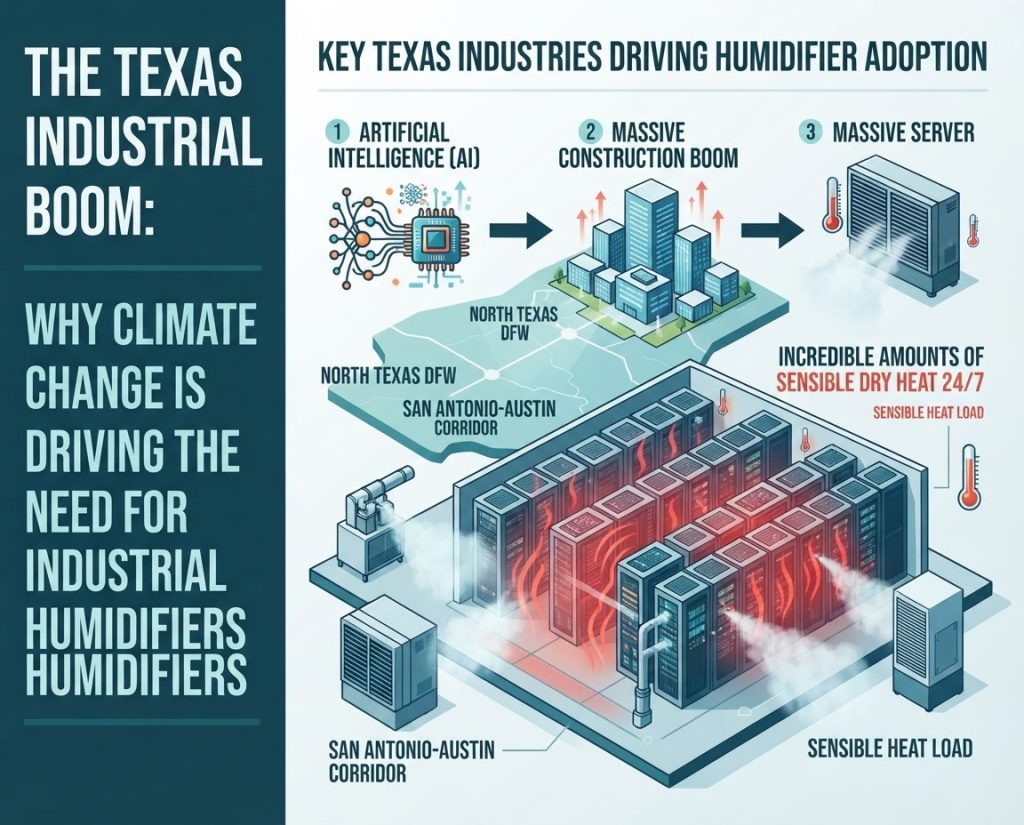
Key Texas Industries Driving Humidifier Adoption
Several surging economic sectors in Texas are heavily reliant on industrial humidification systems to counter the effects of unstable climate conditions:
-
Data Centers and AI Infrastructure
The exponential rise of Artificial Intelligence (AI) has sparked a massive construction boom across North Texas (Dallas-Fort Worth) and the San Antonio-Austin technological corridor. These facilities house massive server farms that generate incredible amounts of sensible dry heat 24/7.
- The Climate Variable: To combat rising ambient summer temperatures and optimize energy costs, many Texas facilities utilize evaporative cooling methods. However, if the outdoor air becomes too dry due to regional droughts, indoor RH can plummet below the safe threshold of 40%.
- The Risk: Low humidity triggers electrostatic discharge (ESD) risks, which can instantaneously fry delicate microprocessor circuitry, leading to severe server downtime and data corruption. Implementing an industrial humidifier ensures a stable moisture blanket that suppresses static and lowers Power Usage Effectiveness (PUE).
-
Semiconductor Manufacturing (The Silicon Prairie)
With massive chip manufacturing investments flowing into Austin, Sherman, and Taylor, Texas is pioneering microelectronics.
- The Climate Variable: Cleanrooms require extreme environmental tightness. Climate-driven swings in atmospheric pressure and temperature compromise building envelopes.
- The Risk: In a semiconductor fab, if relative humidity drops, photoresist chemicals evaporate too quickly, and static electricity causes airborne dust particles to stick to pristine silicon wafers. Industrial humidification maintains a strict ±3% RH tolerance, preventing millions of dollars in scrapped product yield.
-
Aerospace, Defense, and Life Sciences
From rocket assembly in South Texas to defense production in Fort Worth and biotechnology hubs at the Texas Medical Center in Houston, precision air treatment is critical.
- The Risk: Advanced aerospace composites require exact moisture levels during the curing phase to avoid structural micro-cracks. Similarly, pharmaceutical facilities handling powders must maintain a strict humidity “sweet spot” (usually 45%–55% RH). If the indoor air is too dry, organic or chemical powders become statically charged, floating away or sticking to machinery, causing critical dosage inaccuracies and violating FDA regulations.
The ROI of Integrating a Humidifier with HVAC Systems
When evaluating the acquisition of an industrial humidifier, Texas business owners and facility managers must look beyond initial capital expenditure and focus on climate resilience and operational continuity:
- Electrostatic Discharge (ESD) Elimination: Automated moisture control continuously suppresses static risks in high-density electronic zones.
- Reduction of Product Losses: Eliminates chemical evaporation, structural cracking in sensitive materials, and clumping or scattering of pharmaceutical powders.
- Energy-Efficient Adiabatic Cooling: Advanced misting or ultrasonic humidifiers can provide a secondary cooling effect, reducing the load on primary chillers during intense Texas heatwaves.
| Sector | Optimal RH Range | Critical Risk of Dry Air |
| Data Centers / AI | 40% – 50% RH | Server downtime, component destruction via ESD. |
| Semiconductors | 45% – 50% RH | Microchip contamination, chemical evaporation. |
| Pharmaceuticals | 45% – 55% RH | Powder scattering, static machinery adhesion, FDA non-compliance. |
| Aerospace (Composites) | 40% – 60% RH | Material brittleness, micro-fractures during curing. |
Climate change is actively reshaping the environmental baselines of industrial facilities across Texas. As the state positions itself as a global tech powerhouse, the tolerance for operational failure is zero. Investing in a precision industrial humidifier is a strategic business decision that safeguards multi-million dollar investments, guarantees product consistency, and ensures that the state’s fastest-growing industries remain online, resilient, and highly productive regardless of outdoor weather anomalies.