Industrial Heating Solutions: Why Texas’s Booming Oil, Gas, and Fuel Sector Relies on Commercial Water Heaters and Boilers
Category: Water heaters
Texas stands as an undisputed global energy titan. Driven by massive reserves in the Permian Basin, Eagle Ford Shale, and the Gulf Coast refining corridors, the Lone Star State remains the beating heart of the American fuel and energy sector. From large-scale upstream extraction sites and midstream pipeline terminals to downstream petrochemical refineries and fuel distribution hubs, industrial activity across Houston, Midland, Odessa, Beaumont, and Corpus Christi operates at an unrelenting pace.
However, running a high-efficiency, reliable fuel processing or storage operation in Texas requires overcoming severe operational and environmental hurdles. While engineers focus heavily on pumps, compressors, and pipeline integrity, one critical utility is indispensable to daily operations: robust industrial water heating and process heating systems.
To maintain compliance with environmental regulations, prevent viscous fluid bottlenecks, ensure rigorous equipment sanitation, and maintain plant reliability, Texas fuel and energy operators turn to heavy-duty commercial water heaters and industrial boilers—such as the specialized solutions provided by Humiheat.
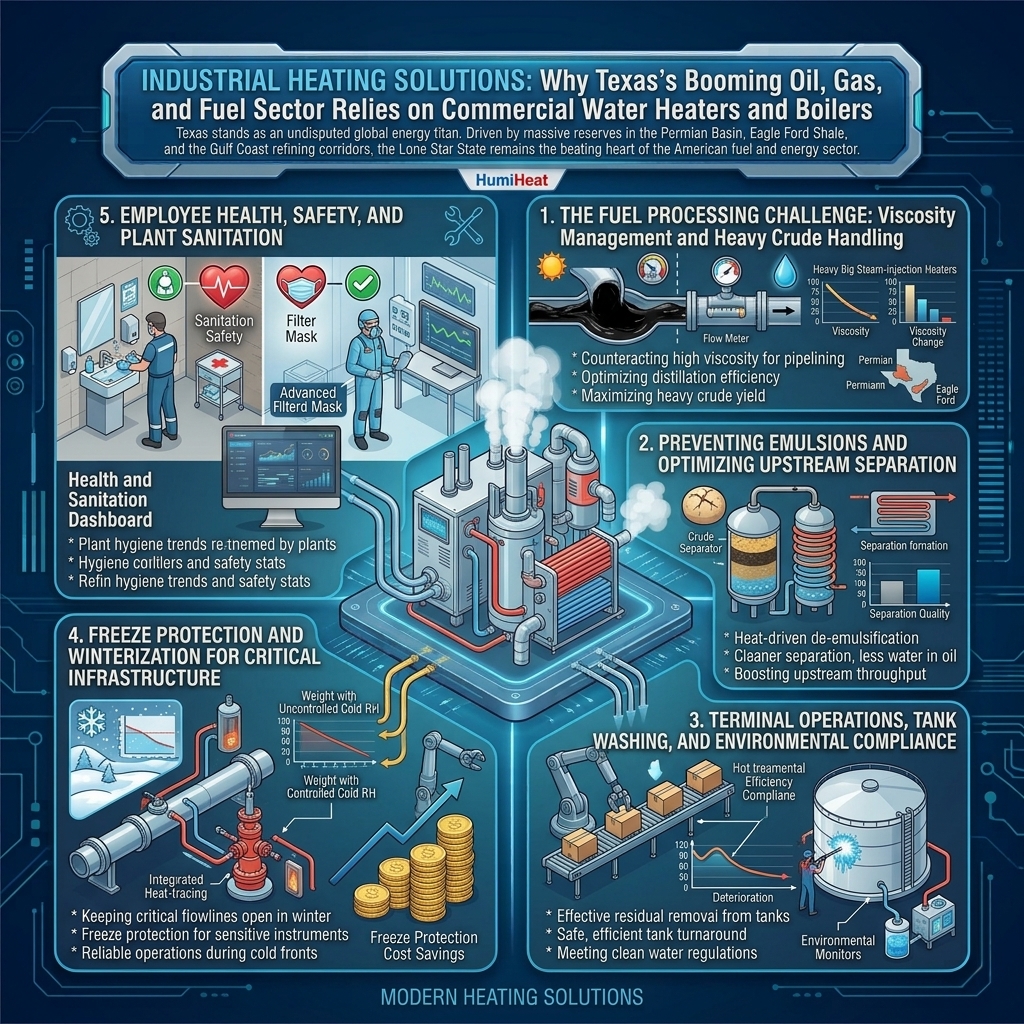
1. The Fuel Processing Challenge: Viscosity Management and Heavy Crude Handling
In the midstream and downstream fuel sectors, handling heavy crudes, refined petroleum products, and industrial biofuels presents constant fluid dynamics challenges. Temperature directly dictates viscosity.
- The Operational Hazard: As crude oils and heavy fuel oils move through storage tanks, separation units, and transfer terminals, ambient temperature drops—especially during unexpected winter freezes or cool Texas nights—cause these hydrocarbons to thicken significantly. High viscosity dramatically increases pumping friction, strains pipeline infrastructure, and reduces throughput efficiency.
- The Heating Solution: Industrial-grade boilers and high-capacity commercial water heaters are deployed extensively to supply continuous thermal energy to tank-heating coils, heat exchangers, and jacketed piping. By maintaining precise fluid temperatures, heavy fuel oils flow smoothly, preventing costly pipeline clogs and ensuring uninterrupted transport across Texas distribution networks.
2. Preventing Emulsions and Optimizing Upstream Separation
Upstream oil and gas extraction operations in the Permian Basin extract a complex mixture of crude oil, produced water, and natural gas. Separating oil from water efficiently is essential before the product can enter pipeline transport.
- The Demulsification Process: Produced water emulsions must be broken down to meet strict pipeline quality standards (typically requiring basic sediment and water levels below 0.5%). Chemical additives alone are often insufficient without the aid of thermal energy.
- Boiler Applications: Industrial water heaters and steam boilers supply the necessary heat to treat heater-treaters and separation vessels. Raising the temperature lowers the oil’s density and interfacial tension, allowing water droplets and impurities to coalesce and separate rapidly. This ensures higher production yields and protects downstream refining assets from corrosive saltwater damage.
3. Terminal Operations, Tank Washing, and Environmental Compliance
Downstream fuel terminals and storage facilities require rigorous maintenance protocols to prevent cross-contamination between different fuel batches (such as diesel, gasoline, and aviation fuels) and to comply with strict federal and state environmental mandates.
- High-Temperature Tank and Vessel Cleaning: Storage tanks must be routinely cleaned, degreased, and inspected. This requires massive volumes of high-pressure hot water and steam to dissolve heavy sludge, paraffin, and asphalt residues accumulated at the bottom of storage silos.
- Reliability Under Pressure: Fuel terminal operators cannot afford equipment downtime. Commercial-grade boilers and water heaters—built with durable materials like copper, cupronickel, or stainless steel—provide the rapid thermal recovery needed to sustain multi-hour heavy washdown operations, ensuring facilities remain compliant with TCEQ (Texas Commission on Environmental Quality) and EPA safety guidelines.
4. Freeze Protection and Winterization for Critical Infrastructure
The 2021 winter freeze in Texas served as a harsh wake-up call for the state’s energy infrastructure. Industrial facilities across the state have since aggressively prioritized winterization and freeze protection to safeguard critical plant assets.
- Protecting Fire Suppression and Utility Lines: Water storage tanks, fire sprinkler systems, and utility water lines exposed to sub-freezing northern or central Texas winter blasts are vulnerable to catastrophic freezing and pipe bursts.
- Integrated Industrial Boilers: Heavy-duty commercial heating systems provide reliable freeze protection loops, keeping utility rooms, critical safety infrastructure, and safety showers at safe operating temperatures. Having a dependable heating backbone ensures that extreme weather events do not force emergency plant shutdowns.
5. Employee Health, Safety, and Plant Sanitation
Refinery and fuel terminal workers operate in high-risk environments, frequently exposed to hazardous materials, petroleum byproducts, chemical residues, and outdoor elements.
- Emergency Eyewash and Safety Showers: OSHA regulations mandate that industrial facilities handling hazardous chemicals must provide tepid water (between 60°F and 100°F) to emergency eyewash stations and safety showers for immediate decontamination. Commercial water heaters ensure that safety compliance is strictly met without risking thermal shock to injured workers.
- General Facility Hygiene: Locker rooms, administrative offices, and maintenance shops across massive industrial complexes require dependable hot water supplies for shift workers around the clock.
Advanced Heating Solutions for the Texas Energy Sector
To meet these demanding industrial requirements, energy operators across Texas rely on engineered, high-efficiency equipment. Modern commercial water heaters and modular boilers—featuring advanced thermal modulation, compact footprints, and high BTU capacities—deliver maximum energy efficiency while minimizing natural gas or propane operating expenses.
For Texas fuel and energy facilities looking to upgrade, expand, or replace their thermal infrastructure, exploring professional-grade systems via specialized platforms like Humiheat provides access to durable, high-performance heating assets designed to endure the rigorous demands of the petroleum industry.
Conclusion
As Texas continues to drive the nation’s energy economy, maintaining resilient, efficient, and compliant thermal infrastructure is paramount for the fuel sector. From controlling fuel viscosity and accelerating upstream separation to ensuring rigorous environmental tank cleaning and reliable freeze protection, industrial water heaters and boilers are true operational linchpins. By investing in heavy-duty commercial heating technology, Texas energy operators protect their equipment, safeguard their workforce, and secure long-term operational profitability.