Applications of humidification equipment in the energy industry
Category: Humidifiers
Tags: Climatization, Control of humidity and temperature, Evaporative fogging systems, humidification, humidification system, humidifier, humidifier system, Humidifiers, Industrial humidifiers
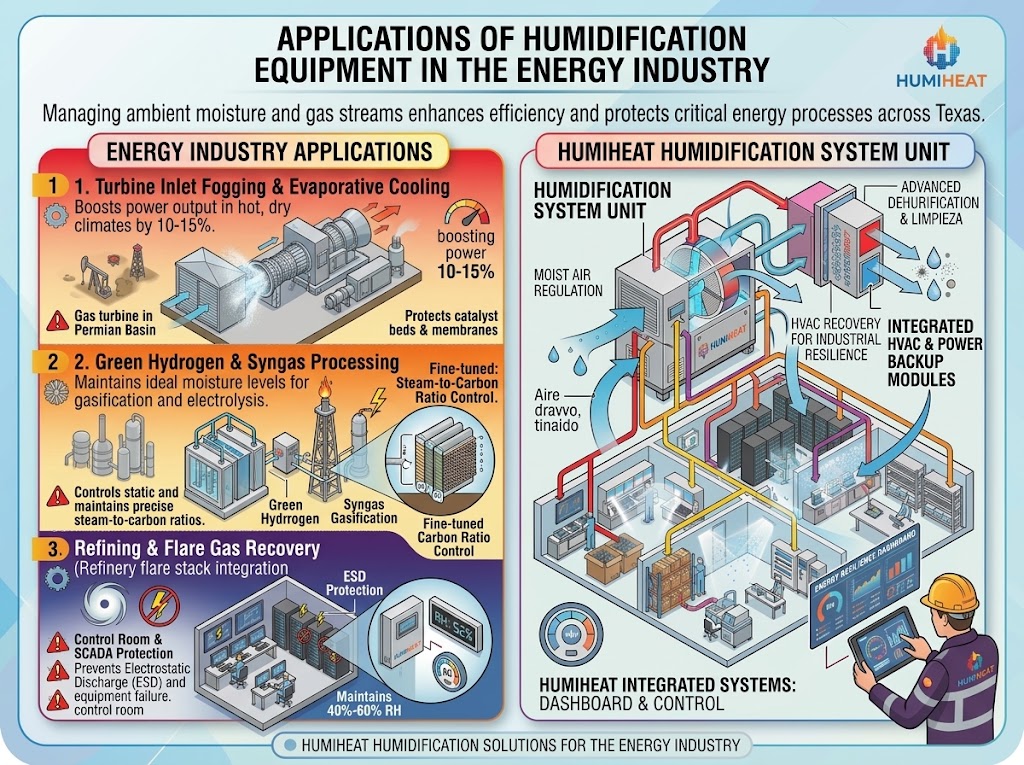
Industrial energy generation and fuel processing facilities in Texas operate under demanding environmental conditions. From gas turbine power plants in West Texas to hydrogen, refining, and renewable energy sites along the Gulf Coast, managing moisture levels in ambient air and process gas streams is essential. Industrial humidification systems play a key role in improving combustion efficiency, maintaining process integrity, and supporting gas conditioning across Texas’s energy sector.
- Turbine Inlet Fogging & Evaporative Cooling: Increases air density for gas turbines in dry, high-heat regions (e.g., Permian Basin), boosting power output by up to 10–15%.
- Green Hydrogen & Syngas Processing: Maintains strict humidity parameters during water electrolysis and gasification to protect catalyst beds and electrolyte membranes.
- Refining & Flare Gas Recovery: Controls static discharge risk and maintains steam-to-carbon ratios in chemical processing units.
- Control Room & SCADA Protection: Prevents Electrostatic Discharge (ESD) damage in mission-critical electronics by maintaining relative humidity (RH) between 40% and 60%.
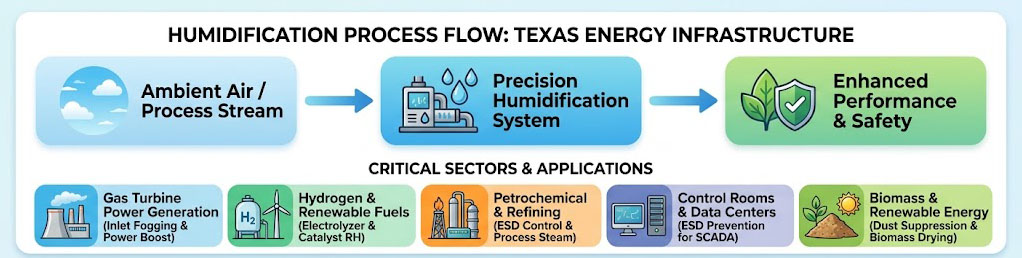
Primary Applications of Humidification Equipment in Texas Energy Infrastructure
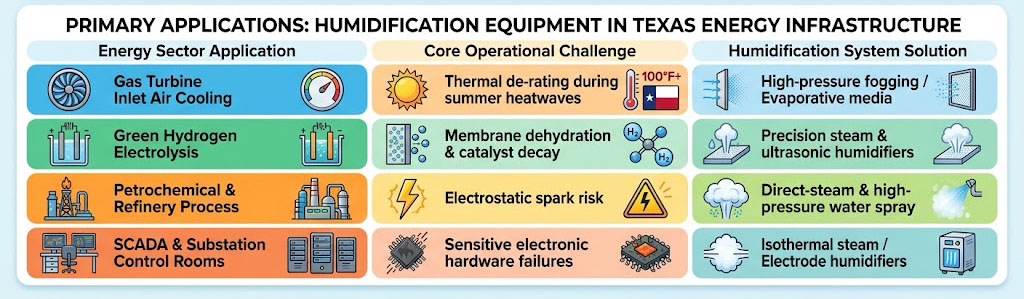
1. Gas Turbine Performance Enhancement (Inlet Fogging)
In regions like Midland, Odessa, and San Antonio, extreme summer temperatures cause ambient air density to drop significantly. Because gas turbines are mass-flow machines, hot, dry air reduces total power output by as much as 15–20%. By installing high-pressure water fogging systems or evaporative cooling media at the air intake, operators cool the incoming air stream toward its wet-bulb temperature. This mass-flow boosting restores lost megawatt capacity when grid demand peaks on ERCOT (Electric Reliability Council of Texas).
2. Green Hydrogen & Clean Energy Transition
Along the Texas Gulf Coast (Houston, Corpus Christi), large-scale green hydrogen hubs utilize Proton Exchange Membrane (PEM) electrolyzers. Maintaining controlled moisture levels in reactant gas feeds prevents membrane drying, reduces degradation, and maximizes electrochemical conversion rates. Specialized ultrasonic and steam humidifiers deliver precise, contaminant-free moisture to maintain process equilibrium.
3. Static Discharge Mitigation in Refineries & Storage Facilities
Hydrocarbon refining and gas processing plants generate volatile organic vapors (VOCs). When ambient humidity drops below 40% RH, the risk of Electrostatic Discharge (ESD) increases dramatically. Industrial humidification equipment keeps relative humidity consistently between 45% and 55%, mitigating static spark ignition hazards in hazardous-rated Class 1, Div 1/Div 2 areas.
4. SCADA & Substation Environment Regulation
Energy distribution relies on uninterrupted SCADA systems and remote-control enclosures. Unregulated dry air inside control rooms leads to static build-up, component damage, and erratic sensor readings. Compact, isothermal steam humidifiers integrated into HVAC ducting ensure continuous climate control and long-term hardware reliability.
Frequently Asked Questions (FAQ)
How does inlet air humidification boost gas turbine efficiency in Texas?
Evaporative fogging systems inject micro-droplets of demineralized water into the inlet air stream. As the water evaporates, it cools the air, increasing its density and mass flow rate into the compressor, directly raising turbine megawatt generation.
Why is humidity control necessary for control rooms in energy plants?
Low relative humidity (below 30% RH) enables static electricity to build up rapidly on surfaces and equipment, increasing the risk of static discharge that can damage sensitive microprocessors and interrupt power distribution monitoring.
What type of water is required for industrial turbine humidification systems?
High-pressure fogging systems require Reverse Osmosis (RO) or Deionized (DI) water to prevent mineral scale deposits from building up on compressor blades and intake filtration media.