Why Texas Food Industry Leaders are Turning to High-Pressure Misting Systems
Category: Humidifiers
Tags: Control of humidity and temperature, Dehumidifiers, Humidifiers, humidity control, humidity sensors, Industrial humidifiers, Temperature control, Texas, Texas food industry
The food and beverage industry in Texas is a powerhouse, driven by a massive supply chain, high-volume production facilities, and an export market that demands uncompromising quality. However, Texas also presents a formidable challenge: extreme heat. With summer temperatures frequently soaring above 100°F (38°C) and persistent drought conditions, maintaining the “cold chain” and worker safety is a constant battle against thermodynamics.
For facility managers and plant engineers across the Lone Star State, high-pressure misting systems have evolved from a luxury comfort feature into a critical piece of industrial infrastructure. In this article, we explore why these systems are essential for the Texas food industry and how they provide a competitive edge in heat management.
The Heat Challenge in Texas Food Production
From the meatpacking corridors of the Panhandle to the sprawling logistics centers in the Dallas-Fort Worth metroplex and the agricultural processing hubs in South Texas, the climate is a major production variable. When ambient temperatures spike, facilities face three specific threats:
- Thermal Stress on Equipment: Refrigeration compressors, chillers, and hydraulic systems work overtime during Texas summers, leading to increased wear and frequent mechanical failures.
- Product Quality Degradation: Perishable goods, particularly fresh produce and meat products, are highly sensitive to temperature fluctuations. Even a brief breakdown in cooling can lead to significant waste.
- Human Factors: Heat stress in non-air-conditioned warehouses and processing floors leads to lower productivity, increased error rates, and heightened risk of workplace accidents, violating critical safety standards (such as OSHA guidelines).
The Solution: Why Misting Systems?
High-pressure misting (also known as adiabatic cooling) is the most efficient response to the Texas heat because it works with the climate rather than against it. By forcing water at high pressure (1,000 PSI) through precision nozzles, the system creates micro-droplets (10-15 microns) that evaporate instantly.
1. Humidity-Neutral Temperature Control
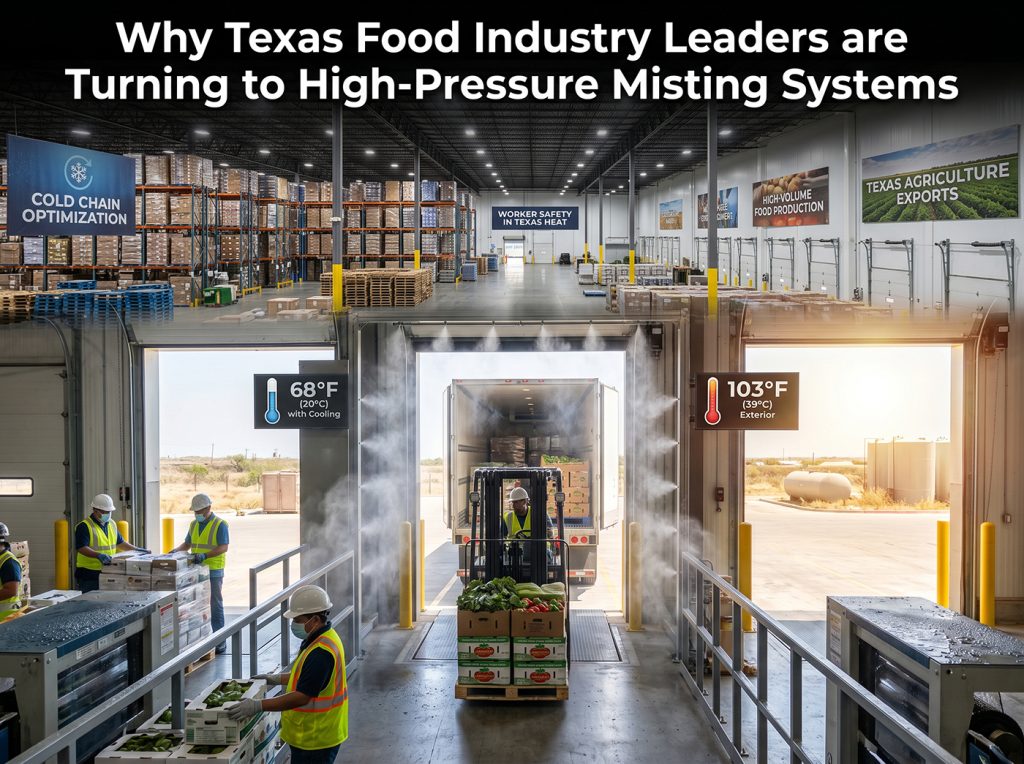
The Texas summer is often characterized by dry heat, which is ideal for evaporative cooling. These systems can lower the ambient temperature by up to 20°F (11°C) without soaking the floor or equipment. By managing the temperature at loading docks and open-air processing stations, plants can stabilize the intake temperature of raw materials.
2. The Logistics Advantage (Loading Docks)
Loading docks are the “weakest link” in the Texas cold chain. Every time a bay door opens, hot Texas air rushes in, forcing the interior refrigeration systems to overcompensate. Installing a “mist curtain” at the loading bay acts as a thermal barrier, preventing the hot outside air from infiltrating the chilled warehouse space. This significantly reduces the load on primary HVAC units and saves on electricity bills.
3. Food Safety and Dust Suppression
In grain processing, bakery facilities, and dried food packaging, air quality is paramount. Misting systems do double duty: they cool the environment and act as a natural dust suppressant. By weighing down airborne particulates, these systems help maintain a cleaner production environment, assisting facilities in meeting rigorous FDA and food safety compliance standards.
Financial and Operational Impact
For Texas food producers, the decision to install a misting system is often driven by Return on Investment (ROI).
- Drastic Energy Savings: Compared to traditional AC, misting systems consume a fraction of the electricity. For facilities with thousands of square feet, this translates into thousands of dollars in monthly operational savings.
- Asset Longevity: By cooling the outdoor air surrounding condensers and chillers, misting systems allow these expensive assets to operate in a cooler micro-environment. This prevents the “high-head pressure” shutdowns that often plague HVAC equipment during peak Texas heat.
- Compliance and Safety: Providing a cooled environment at outdoor or semi-open workstations is the most effective way to protect the workforce from heat-related illness, ensuring the facility remains compliant with Texas labor safety regulations.
Key Considerations for Texas Installations
When selecting a system for a Texas facility, there are specific factors to keep in mind:
- Water Quality: Texas water varies significantly by region. Many areas have “hard water” high in calcium and magnesium. To prevent nozzle clogging and mineral buildup on products, industrial-grade filtration and water softening systems must be integrated.
- Zonification: A large food processing plant in Houston has different humidity needs than one in El Paso. Systems with PLC (Programmable Logic Controllers) and humidity sensors are essential to ensure the system only runs when it can effectively evaporate moisture.
- Maintenance: Texas heat is intense, but the systems are robust. Regular checks on the pump pressure and nozzle integrity are minimal compared to the complexity of maintaining massive refrigeration units.
Conclusion: A Strategy for Texas Growth
As Texas continues to lead in food processing and industrial expansion, the margin for error in temperature control is narrowing. Energy costs are rising, and the heat intensity is not letting up. Industrial misting systems are no longer just for patio comfort—they are a high-performance engineering solution.
By lowering ambient temperatures at the source, shielding the cold chain at loading docks, and protecting the workforce, high-pressure misting systems provide a sustainable, cost-effective way to keep Texas food production running at full capacity—even when the thermometer reads 105°F.
Is your facility ready to combat the summer heat? Integrating adiabatic cooling now is the best way to ensure your bottom line stays cool throughout the Texas summer.