How will the EPA’s 2026 regulations on A2L refrigerants impact the costs of upgrading commercial HVAC systems?
Category: Humidifiers
Tags: A2L refrigerants, A2L system, Climatization, EPA, humidification system, humidifier system, HVAC, Industrial humidifiers, Industrial Refrigeration Dehumidifiers
The year 2026 marks the most significant regulatory shift in the American HVAC industry since the phase-out of R-22. Under the EPA’s American Innovation and Manufacturing (AIM) Act, the transition to A2L refrigerants (such as R-454B and R-32) is no longer a future projection—it is a mandatory reality for all new commercial installations.
For building owners and facility managers, this transition directly impacts the capital expenditure (CAPEX) and long-term operating expenses (OPEX) of HVAC upgrades. Here is a detailed breakdown of how the 2026 regulations are reshaping the costs of commercial climate control.
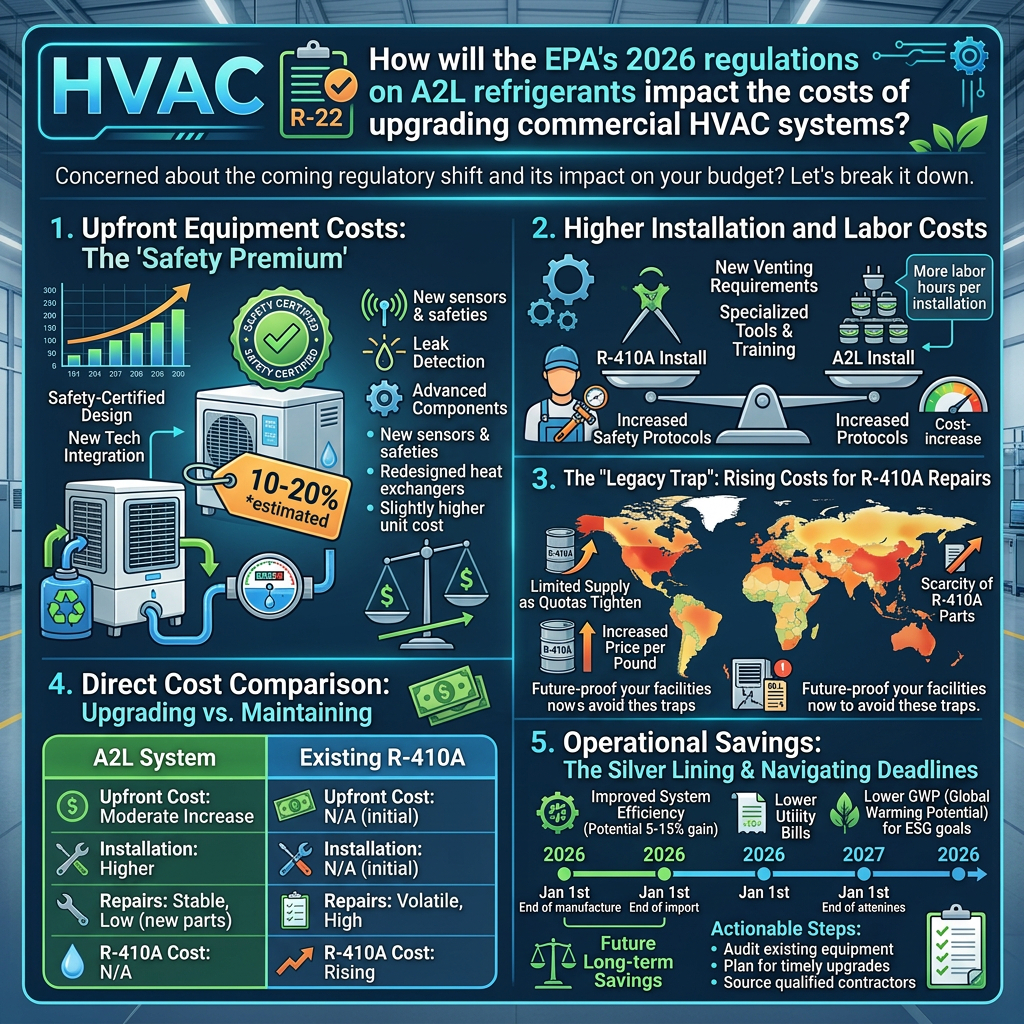
1. Upfront Equipment Costs: The “Safety Premium”
The most immediate impact of the 2026 mandate is a rise in the base price of equipment. Industry data for early 2026 shows that new A2L-compliant units are roughly 15% to 25% more expensive than the outgoing R-410A models.
This price increase is driven by the technical requirements of handling “mildly flammable” refrigerants. Because A2Ls are classified as ASHRAE Class 2L, manufacturers have had to re-engineer systems to include:
- Integrated Leak Detection Systems (LDS): New units now feature sensors that automatically shut down the compressor and activate ventilation if a leak is detected.
- Mitigation Boards: Specialized electronics designed to manage safety protocols in real-time.
- Spark-Proof Components: Upgraded electrical contactors and sealed motors to eliminate potential ignition sources.
2. Higher Installation and Labor Costs
Upgrading to an A2L system in 2026 requires more than just a “drop-in” replacement. Contractors are facing higher operational costs, which are inevitably passed down to the consumer:
- Specialized Tooling: Technicians must use A2L-certified vacuum pumps, recovery machines, and leak detectors. These tools are often more expensive than traditional versions.
- Extended Installation Times: Compliance with the updated UL 60335-2-40 safety standards requires more rigorous pressure testing and sensor calibration during the commissioning phase.
- Training and Certification: The industry has seen a surge in labor rates as specialized, A2L-certified technicians become a high-demand commodity.
3. The “Legacy Trap”: Rising Costs for R-410A Repairs
For those choosing to repair old systems rather than upgrade, 2026 brings a different kind of financial pressure. The EPA has drastically cut the production of HFCs (like R-410A) by 40% as of early 2026.
- Refrigerant Scarcity: The price per pound of R-410A has nearly doubled in the last 18 months. A simple recharge for a 10-ton rooftop unit that cost $800 in 2024 can now exceed $1,500.
- The 15lb Threshold: New EPA management rules now require stricter leak inspection and reporting for any commercial system containing 15 pounds or more of high-GWP refrigerant. This creates an ongoing administrative and maintenance cost for older systems that A2L units (with their lower GWP) may partially bypass.
4. Operational Savings: The Silver Lining
While the initial investment is higher, the move to A2L refrigerants offers a path to lower utility bills.
- Increased Efficiency: A2L refrigerants generally have better heat transfer properties than R-410A. On average, new 2026-compliant commercial systems are 5% to 10% more energy-efficient, allowing large facilities to recover a portion of the upgrade cost through lower monthly energy consumption.
- Future-Proofing: By installing an A2L system now, building owners avoid the “obsolescence tax.” Transitioning in 2026 ensures that refrigerant for future repairs will be readily available and affordable for the next 15–20 years.
5. Navigating the 2026 Deadlines
It is critical to note that the EPA’s January 1, 2026 deadline applies to the installation of new equipment for most light commercial applications.
- Inventory Sell-Through: While there are limited “sell-through” periods for equipment manufactured before the deadline, supply is tightening rapidly.
- VRF Exceptions: Some complex Variable Refrigerant Flow (VRF) systems have extended deadlines into 2027 or 2028, but for standard rooftop units (RTUs) and split systems, the transition is full-force today.
Conclusion: Strategy Over Reaction
The EPA’s 2026 regulations have undeniably increased the price of entry for commercial HVAC upgrades. However, when you factor in the soaring cost of maintaining R-410A equipment and the energy gains of A2L technology, the “expensive” upgrade often proves to be the most fiscally responsible move.
To mitigate these costs, facility managers should prioritize comprehensive energy audits and explore federal tax credits (like Section 179D), which were specifically designed to offset the higher price of these eco-friendly, high-efficiency systems.